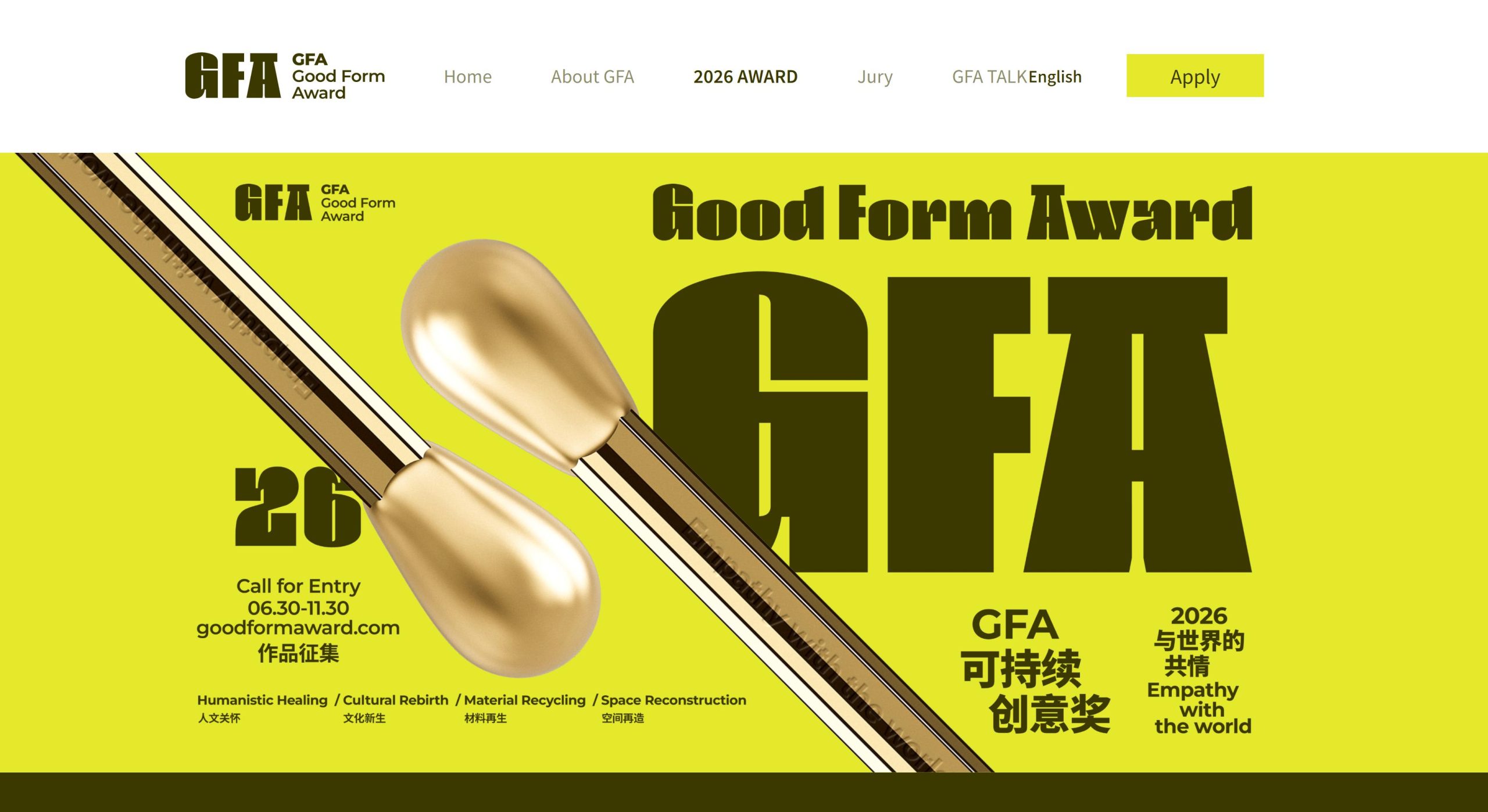
Deadline: 30 November 2026
Good Form Award 2026
Organizer: Sustainable Design and Art Promotion Association (SDA)
Region: International (no nationality or major restrictions; projects may come from different regions and issue contexts)
Deadline: 30 November 2026
Competition Categories: Four entry categories
- Humanistic Care — focuses on mental health, inclusive design, and emotional repair, exploring how design can respond to human vulnerability and need through real connection. Accepted work types include but are not limited to: visual narrative (emotional works presented through graphic design, photography, video, illustration, and related media), interactive installation (works with emotional response or companionship functions), service design (systematic design solutions for mental health and emotional support), product design (physical or digital products for psychological healing and emotional management), community art projects (participatory practices for specific communities), spatial experience design (healing spatial concepts or implemented plans)
- Cultural Rebirth — revives intangible heritage, local narratives, and identity, bringing fading cultures back into contemporary life. Accepted work types include but are not limited to: cultural research and visual translation (contemporary interpretations of local culture), intangible heritage innovation (combining traditional craft with contemporary life), cultural branding and identity systems (systematic visual design for cultural IP), documentary video (recording and creating around cultural memory and ways of life), cultural curation (curatorial design for cultural communication and activation), digital culture projects (cultural expression using new media technologies)
- Material Regeneration — explores circular materials, craft experiments, and lifecycle thinking to build a more honest and responsible relationship between materials and creative practice. Accepted work types include but are not limited to: material experimentation and R&D (exploration of new sustainable materials), circular design systems (sustainable solutions across a product lifecycle), waste transformation (creative conversion and application of discarded materials), ecological craft research (traditional or innovative regenerative craft practices), packaging and container design (degradable and recyclable packaging solutions), material narrative works (artistic expression through materials)
- Spatial Renewal — examines public space, marginalized communities, and human scale, asking how design can redistribute spatial power and warmth. Accepted work types include but are not limited to: architectural concept design (innovative proposals for future living or public architecture), urban renewal (design for transforming and activating communities and neighborhoods), accessibility and inclusive design (solutions that improve spatial access), temporary spaces and installations (pop-up, festival, and other temporary spatial designs), landscape and public space (design interventions in outdoor environments), virtual space design (spatial experience innovation in digital environments)
Eligibility: Four categories of entrants, all with no nationality restrictions; projects may come from different regions and issue contexts
- Student entrants: undergraduate, graduate, and continuing-education students currently enrolled, or who graduated within the previous year (on or after June 2026); no restrictions on major or nationality
- Individual entrants: independent designers, artists, and creative practitioners may submit under their own authorship; no nationality restrictions
- Company entrants: studios, agencies, art institutions, in-house design teams, innovation teams, and CSR teams may submit socially valuable design-practice projects under their organization's name
- Non-profit entrants: non-profit institutions and public-interest organizations may submit socially valuable design-practice projects under their organization's name
Entry Fee: Tiered by entrant type
- Student entrants: Free (valid proof of enrollment required)
- Individual entrants: RMB 1,280 (up to five creators may be listed per work)
- Company entrants: RMB 1,680 (no creator limit per work)
- Non-profit entrants: Free (proof of non-profit status required)
- Official invoices are issued for all entry fees; non-profit organizations and creators in remote areas may apply for fee reductions by contacting the official email
Prizes/Awards: Five award levels; all winners receive prominent inclusion in the official portfolio, an exhibition position, and an in-depth GFA TALK feature
- Best Creativity Award: the annual top honor, awarded to outstanding work that creates lasting impact in real-life contexts and fully embodies the Good Form spirit; winners receive a key position in the annual exhibition and connections to relevant creative resources
- Gold Award: awarded to works that stand out in their category, express a clear social perspective, and demonstrate a responsible creative approach; winners receive an important exhibition position and connections to relevant creative resources
- Silver Award: awarded to works that show a sincere understanding of their subject and make an effective intervention through creative practice; winners receive an exhibition position and connections to relevant creative resources
- Bronze Award: awarded to works with clear social awareness, a focused creative direction, and value worth seeing and documenting; winners receive an exhibition position and connections to relevant creative resources
- Award of Excellence: awarded to creative practices that may not yet be fully developed but are hard to ignore in at least one meaningful dimension; winners receive an exhibition position and an in-depth GFA TALK feature
Core Introduction: The Good Form Award is the first creativity award centered on sustainable design and art, organized by the Sustainable Design and Art Promotion Association (SDA). The GFA Manifesto states that creativity should understand the lived realities of others, respect social boundaries, and take responsibility for the long-term impact of its work; the award focuses on the lasting impact of work in real-life contexts rather than visual presentation alone. The 2026 jury comprises 21 independent voices from different fields. GFA emphasizes the independence and honesty of its review process and runs the ongoing GFA TALK dialogue series. To apply: contact hello@goodformaward.org.