Deadline: 1 December 2026
The Aftermath Project 2026 Post-Conflict Grant
Cash Prize / December / Exhibition / Fine Arts & Photography / Open to All / Trophy / Certificate91 views
Organizer: The Aftermath Project (non-profit founded in 2007 by photographer Sara Terry; Interim Executive Director Andrew Cullen)
Location: United States (non-profit base), open to photographers worldwide
Deadline:
- Application deadline: 1 December 2026 (midnight PST)
- Results announced: by the end of December 2026 (all applicants notified by group email before the public announcement)
- Funded project completion: 1 January 2028; photographs delivered by 1 May 2028
Competition Category: A single category — a production grant for still-photography projects addressing the aftermath of conflict. Proposals may relate to the aftermath of international wars, regional insurgencies, ethnic violence, urban riots, or community-level conflict; in general the conflict should be over for a situation to be deemed an "aftermath," though cases of prolonged or ongoing conflict, or situations that are themselves the result of an aftermath, will also be considered. Proposals about the aftermath of domestic violence or environmental disaster are not accepted unless clearly framed as the aftermath of conflict. Explicitly excluded: grant funds may not be used to produce video or audio content, exhibitions, or books.
Eligibility: Open to working photographers worldwide developing still-photography projects on post-conflict issues; full-time students are not eligible; employees and directors of The Aftermath Project, advisory board members, current-year grant judges, and their immediate families are not eligible; only submissions including all required materials will be considered
Entry Fee: Free to enter
Prizes/Awards:
- One grant winner: US$25,000 production grant
- Four additional photographers named finalists
- Funds distributed in stages: 50% at project onset, 40% after interim reports, remaining 10% upon delivery of 12 prints
- The winner must provide The Aftermath Project with 12 prints (chosen jointly, at least 16 × 20 inches) for its archive, and make at least 30 images from the grant work available for possible exhibition and/or publication
- Finalists must make 10–15 images available for possible exhibition and/or publication
- Winners and finalists retain all copyright; work may be used for educational and community outreach purposes (including lesson plans), publicity and press, always with the photographer's credit/copyright line; any third-party compensation is split 50-50 with the photographer
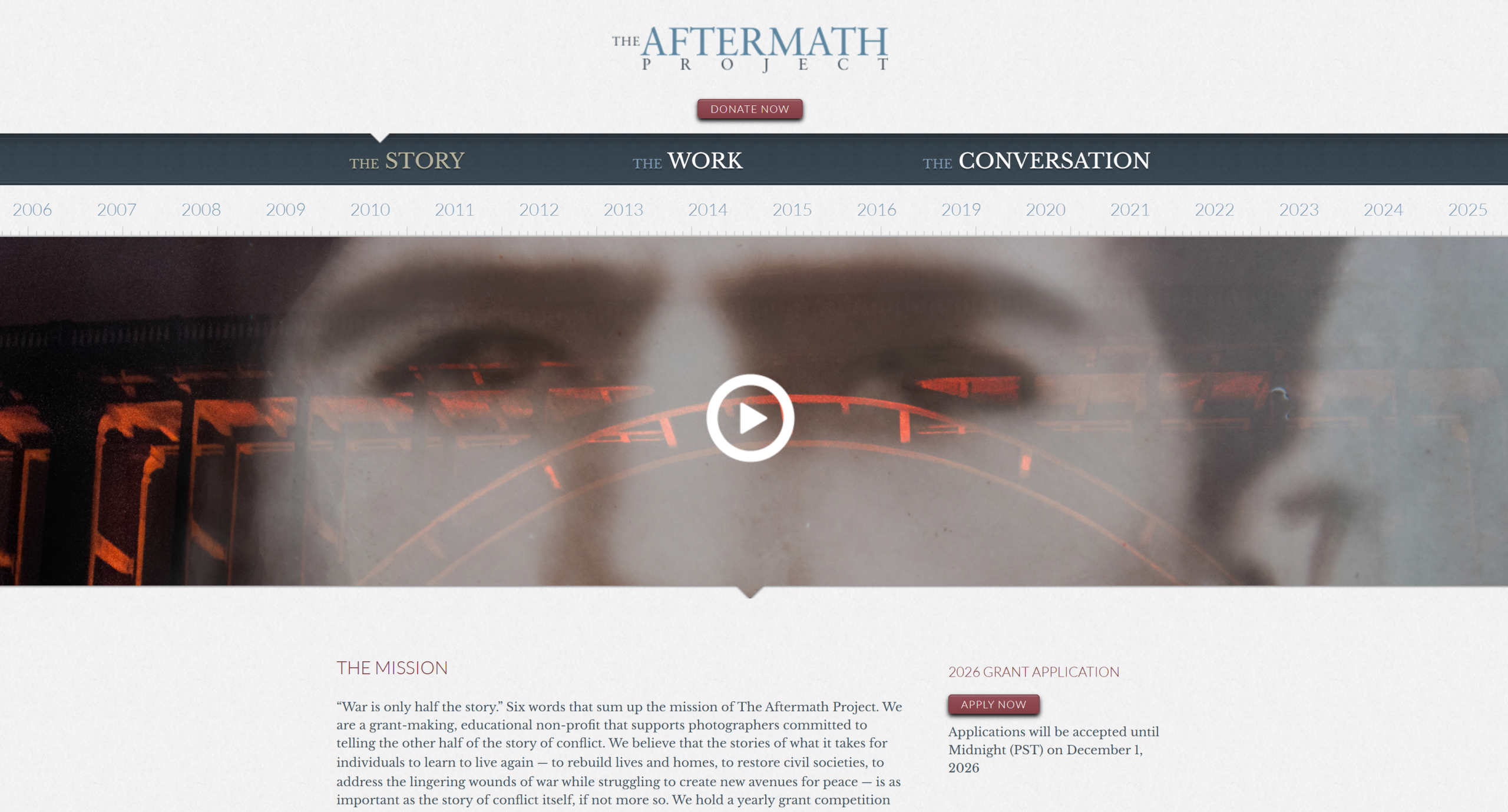
Core Introduction: Founded in 2007 by photographer Sara Terry, The Aftermath Project supports photographic projects that tell the other half of the story of conflict — what it takes for individuals to learn to live again, to rebuild destroyed lives and homes, to restore civil societies, and to address the lingering wounds of war while struggling to create new avenues for peace. In announcing the 2026 grant, the organization noted that several recent grant recipients have addressed the fallout of conflicts in Ukraine and Gaza that are still ongoing, underscoring that the need to recognize and understand still-unspooling aftermaths is as great as ever. Application requirements: (1) a signed application form saved as PDF or jpg; (2) a project proposal of no more than two pages as a .doc or .docx file, beginning with a one-sentence summary statement and indicating any publishing or exhibition commitments for the proposed work; (3) a portfolio of no more than 30 jpg images, sized 1,200 pixels on the longest side at 72 dpi with a maximum file size of 2 MB per photo, labeled "lastname_number.jpg" (e.g., Smith_1.jpg) with caption information in each file's File Info section; (4) a caption sheet as a .doc or .docx file with descriptions and dates for each photo; (5) a short bio of no more than two paragraphs as a .doc or .docx file. Nothing else should be sent. Materials are submitted via a file-sharing service such as WeTransfer, Google Drive, or Dropbox to aftermathprojectinfo@gmail.com, with a confirmation of receipt sent in return. The project statement carries as much weight as the photographs in judging; no budget is required, but the proposal should indicate the scope of work planned during the grant year (travel, research, etc.). Applicants who have not yet begun their proposed project may apply by submitting other work demonstrating photographic and storytelling skills. Extensions of a few days are granted only under extraordinary circumstances such as natural disasters.