Deadline : November 30, 2026
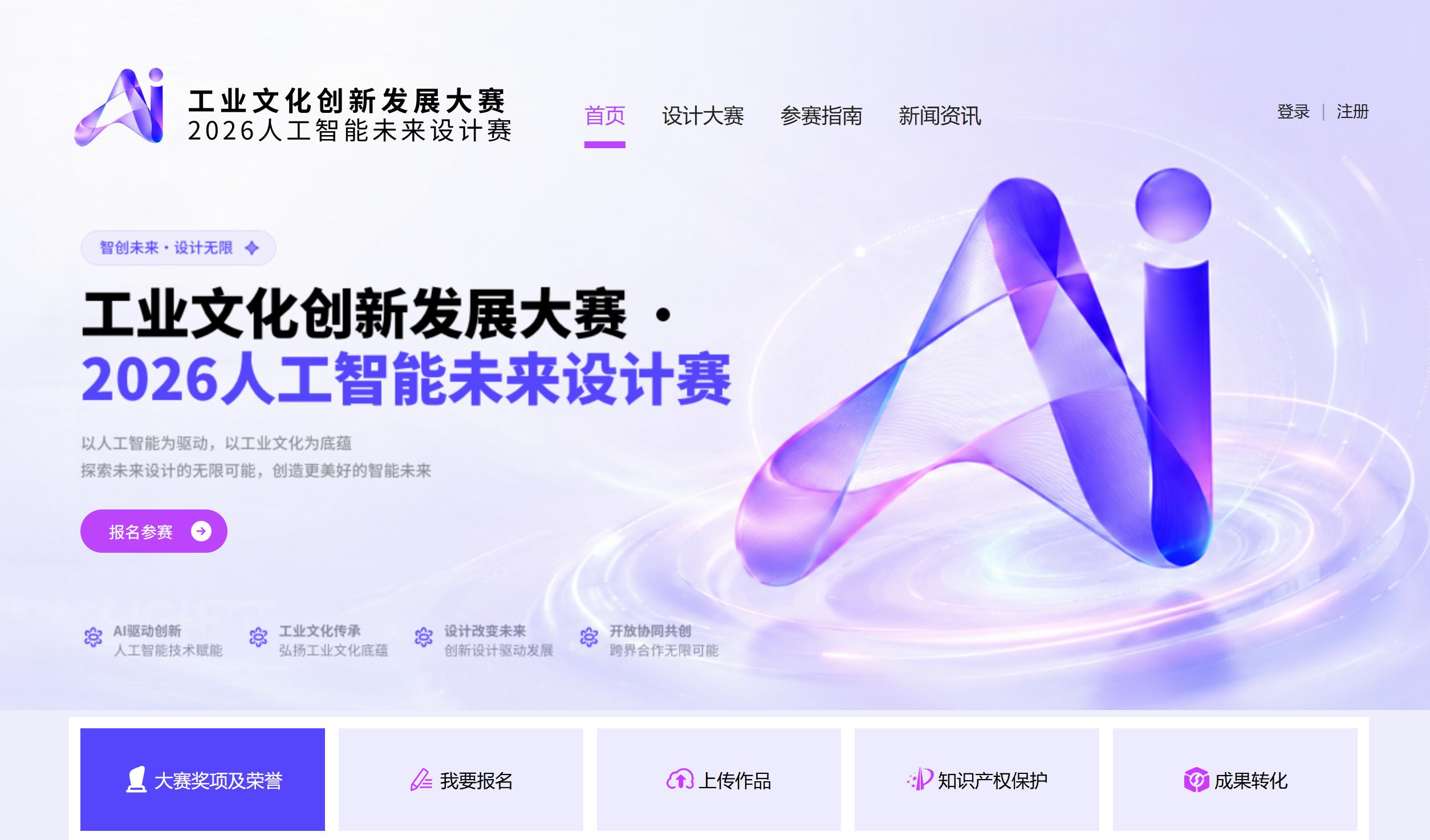
Industrial Culture Innovation & Development Competition · 2026 AI Future Design Competition
Organizer
Organizer: Industrial Culture Development Center of the Ministry of Industry and Information Technology of China (MIIT). Co-organizers: Dongguan Fashion & Creative Industrial Design Research Institute; Deli Space-Time Gravity City · Fashion Creative Industry Eco-Park; Shanghai Industrial Culture Development Foundation; Lingang Special Area · Linjing Xingke OPC International Community.
Location
China, open to participants at home and abroad (an Overseas Group is open to foreign SMEs, experimental institutions, startups, independent creators, and Sino-foreign joint innovation teams). Registration is online; the national advancement round and national finals take place in China (venues to be announced).
Deadline
Registration deadline : November 30, 2026
Competition Category
Three competition tracks:
- Open Theme Track (5 themes, judged separately):
① Smart Wearables — wearable interaction and smart-experience fashion innovation, including sensing and feedback, flexible electronics, smart materials, ergonomics, and health/emotion/stage applications;② Trend Culture — guochao (China chic) narratives, anime culture and original designer-toy IP, Gen Z expression;
③ Lifestyle Fashion — multi-scene wearable categories including apparel, accessories, bags, watches, jewelry, eyewear, and footwear;
④ Green & Eco — recycled materials, low-carbon processes, disassembly and recyclability, circular design and life-cycle expression;
⑤ Creative Challenge — for university students and AI-tool enthusiasts; no mandatory physical production, 3D modeling, or hardware development; digital works such as AI-generated images, creative short videos, concept posters, interaction prototypes, and product storyboards are accepted.
- Themed Track (4 set themes, judged together; a Creation Statement is required):
① Beauty of Manufacturing [Precision Tools & Forms] — precision craftsmanship, structural aesthetics, modular design, artisan spirit;② Beauty of Time [Temporal Humanities] — rhythms of time, memory, material transformation, spatio-temporal imagery;
③ Beauty of Industry [Systems & Macro Structures] — industrial signage systems, functional aesthetics, strong visual identity;
④ Beauty of Aerospace [Cosmic Innovation] — aerospace spirit, future protection, human-machine collaboration, lightweight tech materials.
- OPC Innovation & Entrepreneurship Track (3 themes, judged together; verifiable deliverables required — prototypes, runnable demos, commercial-ready digital source files):
① AI+Hardware — spatial-computing smart wearables, AR/XR terminals, immersive cultural-tourism smart hardware;② AI+Software — AI content-generation and restoration toolchains for spatial-computing terminals and digital-twin scenarios;
③ AI+Products — high-precision, standardized digital-twin products and XR virtual-scene immersive consumer applications.
Participants compete in three groups: Maker Group (faculty and students, independent designers, freelance creators, individual/startup teams), Enterprise Group (legally registered fashion, design, tech, cultural-creative, and smart-manufacturing companies and institutions), and Overseas Group.
Eligibility
Open to all. Domestic and international makers, enterprises, university faculty and students, independent designers, creators, experimental institutions, OPC companies, and Sino-foreign joint innovation teams are all welcome.
Entry Fee
Free to enter.
Open Theme and Themed track entries register via the official website tscup-design.com; OPC Innovation & Entrepreneurship track entries are submitted by email to linstarx@tcdic.com.
- Open Theme Track: each theme awards 1 Gold, 2 Silver, 3 Bronze, plus individual/special awards; one overall Grand Prize is also conferred — the year's highest "Smart Trend Fashion Design" award, selected from all final-round works.
- Themed Track: 1 Gold, 2 Silver, 3 Bronze, plus individual awards; winning works may be selected for inclusion in the Tiangong digital collection platform.
- OPC Track: 1 Gold, 2 Silver, 3 Bronze, plus individual awards; finalists may be admitted to a dedicated industry incubation system.
- Excellence Awards: official honorary certificates for works advancing to the national round but not the finals; Organization/Mentor Awards for outstanding institutions, schools, and supervising teachers.
- Rewards follow a "certificate + trophy + benefits pool" model: the benefits pool is worth RMB 10,000–100,000 in exhibition and showcase opportunities, media promotion, industry matchmaking and commercialization, incubation and investment/financing connections, talent development and industry-education integration, international exchange, and study tours (valid for 12 months after the winners are announced; where one work wins multiple awards, only the highest benefit tier applies).
Core Introduction
The Industrial Culture Innovation & Development Competition · 2026 AI Future Design Competition is a national-level competition hosted by the Industrial Culture Development Center of China's MIIT, implementing the national "AI+" initiative and driving the deep integration of AI with fashion design, advanced manufacturing, and the digital culture industry. Focused on four fusion dimensions — AI+hardware, AI+software, AI+design, and AI+products — it offers three tracks (open creation, set themes, and OPC innovation & entrepreneurship) spanning creative practice, industrial aesthetic innovation, and startup incubation, encouraging participants to create original work with AI across diverse scenarios and to industrialize the results. It aims to build China's benchmark "AI + Art + Fashion" fusion-innovation platform and support the intelligent, digital, and brand upgrading of China's fashion industry. Accepted work formats range from purely digital outputs, digital-physical hybrids, and concept designs to AI creative films and sampleable, wearable, presentable, or mass-producible products/projects; entrants must submit an AIGC usage statement, and intellectual property remains with the entrants. Supporting resources include expert mentoring, brand and supply-chain matchmaking, prototyping and mass production, channel partnerships, investment connections, and IP incubation.