
Deadline: December 1, 2026
Stanford Center on Longevity Design Challenge 2026-2027
- Registration Opens: September 15, 2026
- Submission Deadline: December 1, 2026 (11:59 PM Pacific Time)
Four longevity-related tracks (teams choose one):
- Mobility and Physical Safety: Robotics that support independent movement and community participation for people with changing physical abilities
- Caregiving and Daily Living: Robotics that reduce caregiving burdens across the lifespan (e.g., for new parents, partners managing chronic conditions, or adult children caring for aging relatives)
- Social Connection and Cognitive Health: Robotics that foster meaningful interaction, intergenerational connection, and cognitive engagement
- Sustainable Cities and Aging Infrastructure: Robotics that help people maintain community participation when constrained by urban environments, physical limitations, or driving cessation
- Open to teams of 1-5 students enrolled during the 2026-2027 academic year at any accredited university or college globally
- Each team must have at least one full-time student; only students may present at the finals if selected
- Cross-university teams allowed; non-student members allowed (non-university students must be on a team with at least one university student)
- No field restrictions — design, engineering, business, social sciences, law, sciences, education, humanities all welcome
- Individual participation allowed
- 1st Place: $10,000
- 2nd Place: $5,000
- 3rd Place: $2,000
- Finalist teams (5-8 teams): $1,000 each + one-on-one mentorship from industry experts and researchers
- Finalists invited to Stanford University for a three-day finals event (limited travel reimbursement provided)
- Prize money is subject to US income tax (Form 1099 issued)
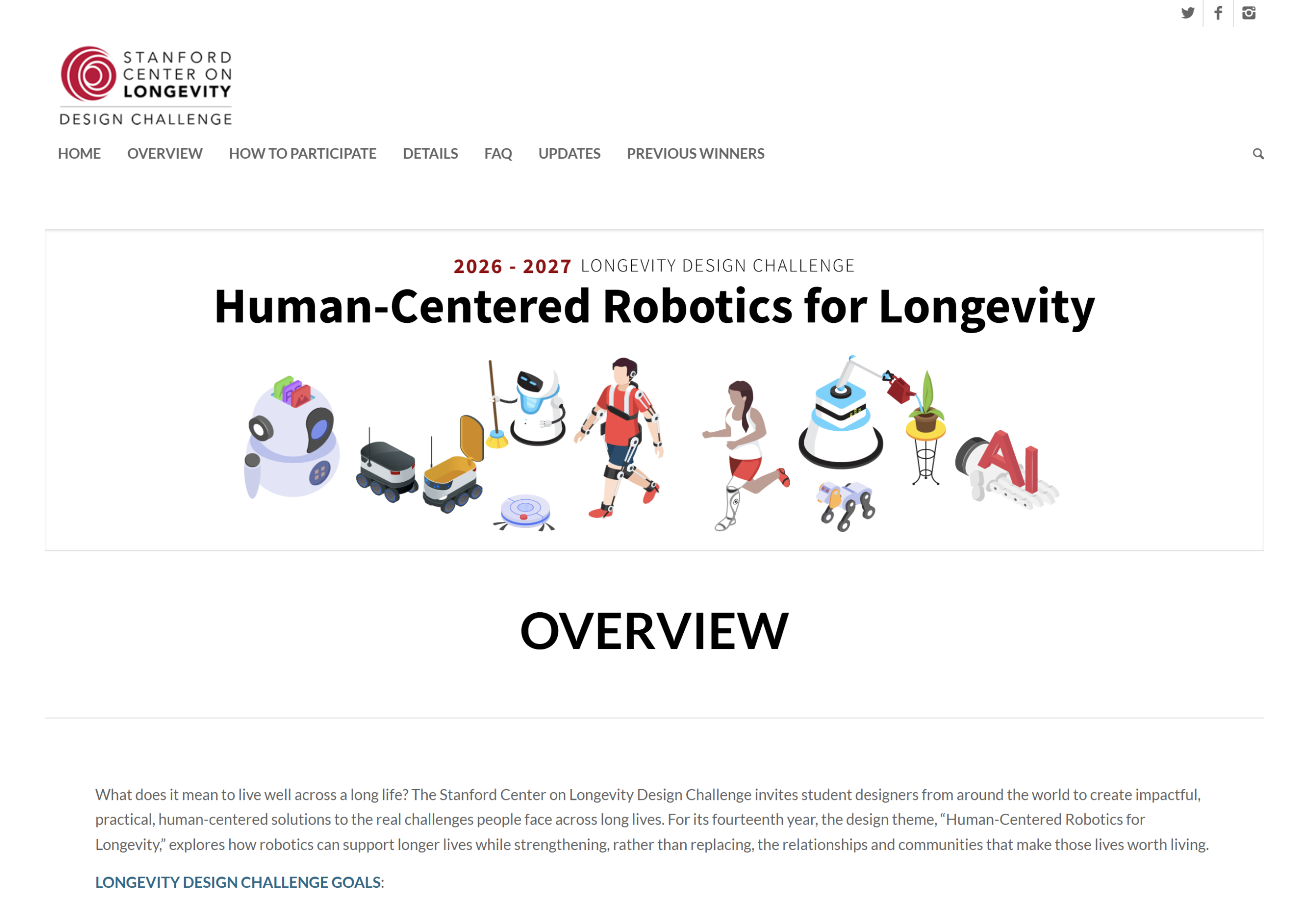
Now in its fourteenth year, the Stanford Center on Longevity Design Challenge 2026-2027 invites students worldwide to create practical, human-centered robotics solutions under the theme "Human-Centered Robotics for Longevity." The competition challenges student designers to develop robotic tools — ranging from low-cost mechanical devices to interactive smart systems — that address longevity-related challenges in mobility, caregiving, social connection, and urban adaptability, while strengthening rather than replacing human relationships and community bonds. The competition runs in two phases: Phase I is concept ideation (idea submission, no prototype required), and Phase II invites finalist teams to further develop their solutions and deliver a seven-minute pitch followed by a five-minute Q&A on Stanford's campus. Judging criteria: Impact 40%, Feasibility 30%, Originality 20%, Affordability 10%, with a separate theme alignment score applied as a weight. Since 2013, the competition has attracted entries from over 50 countries, with past winners from Stanford, MIT, National University of Singapore, IIT, National Taiwan University of Science and Technology, and other leading institutions worldwide.