Deadline: November 20, 2026
HRI 2027 Student Design Competition — Robots in Public Spaces Organizer
Organizer
ACM/IEEE International Conference on Human-Robot Interaction (HRI)
Location
International (Conference venue: Santa Clara, California, USA; March 8–12, 2027)
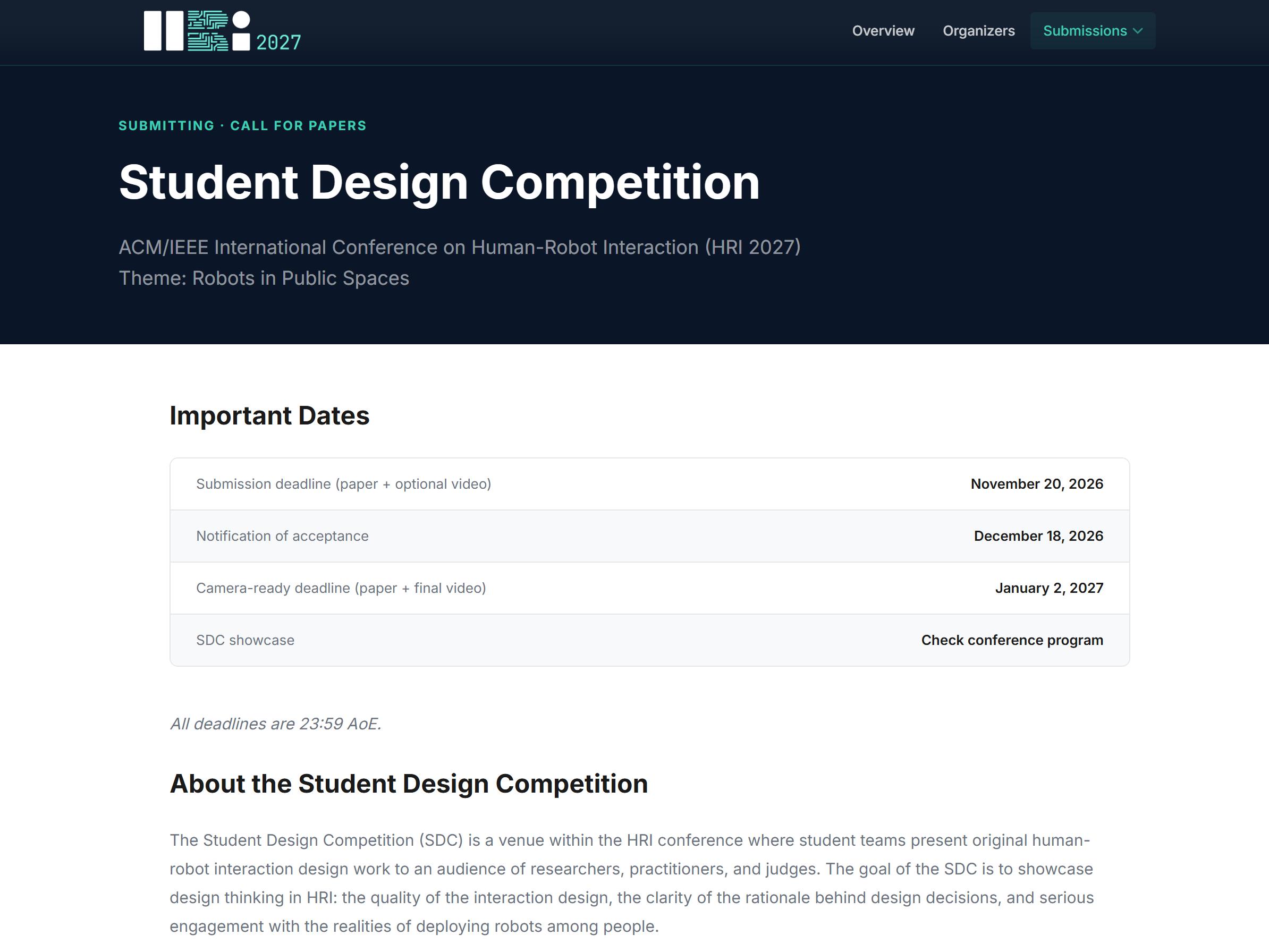
- Submission Deadline (paper + optional video): November 20, 2026 (23:59 AoE)
- Notification of Acceptance: December 18, 2026
- Camera-Ready Deadline (paper + final video): January 2, 2027
- SDC Showcase: During the conference (March 8–12, 2027)
- Physical Robot Systems — new platforms built from scratch, or existing/commercial platforms where the design contribution is a modification, a new interaction, or software-based behavior
- Software-Only Systems — e.g., conversational agents, coordination systems, or interfaces mediating human-robot encounters in shared spaces
- Interaction Concepts and Scenarios — well-developed interaction designs demonstrated through enactment, video prototyping, Wizard-of-Oz techniques, or similar methods
- Spatial and Service Design Concepts — designs addressing how robots, people, and public environments are configured around one another
Eligibility
Student teams only. Students at any stage — undergraduate through PhD — and from any discipline are eligible; multidisciplinary teams are encouraged. Team size: 2–5 students; members may be at different institutions, and no student may be on more than one team. Faculty advisors may appear as co-authors, but the project must be student-led with student contributors listed first. Projects do not need to be finished at the submission deadline, provided the paper describes the final deliverable concretely and remaining work is realistic before the camera-ready deadline.
Entry Fee
Free
- Best Design Award — selected by the judging panel using the published rubric
- Public Spaces Award — for the submission that most deeply engages the theme, selected by the judging panel
- People's Choice Award — selected by conference attendees by open vote during the showcase
- All accepted team papers will be published in the HRI 2027 proceedings (non-archival companion category)
- Note: Travel funding is not currently guaranteed; teams are encouraged to explore IEEE RAS travel grants, the HRI Student Volunteers program, and home institution scholarships
Core Introduction
The HRI 2027 Student Design Competition (SDC) is a student competition track within the 22nd ACM/IEEE International Conference on Human-Robot Interaction, with the 2027 theme "Robots in Public Spaces." The goal of the SDC is to showcase design thinking in HRI: the quality of the interaction design, the clarity of the rationale behind design decisions, and serious engagement with the realities of deploying robots among people. The theme is interpreted broadly, covering physical public and quasi-public environments such as sidewalks, plazas and parks, museums and libraries, airports and train stations, hospital lobbies, elderly-care facilities, and other shared institutional spaces — settings that are multi-party, socially complex, and messy. Projects may take the form of physical robot systems, software-only systems, interaction concepts and scenarios, or spatial and service design concepts. The competition does not require full-fidelity prototypes or any particular level of autonomy; low-fidelity or puppeted ("Wizard-of-Oz") demonstrations are fully acceptable, and expensive hardware is not required and confers no advantage — a rigorous, well-argued software or conceptual design can win. Evaluation prioritizes design quality, rationale, and engagement with public-space challenges over raw technical complexity. Submissions require a paper of up to 4 pages in HRI proceedings format (design-centric extended abstract, non-anonymous) and an optional but strongly encouraged video of up to 3 minutes. At least one member of each accepted team must register for and attend HRI 2027 in person to present at the SDC showcase.